MonuMoney.in
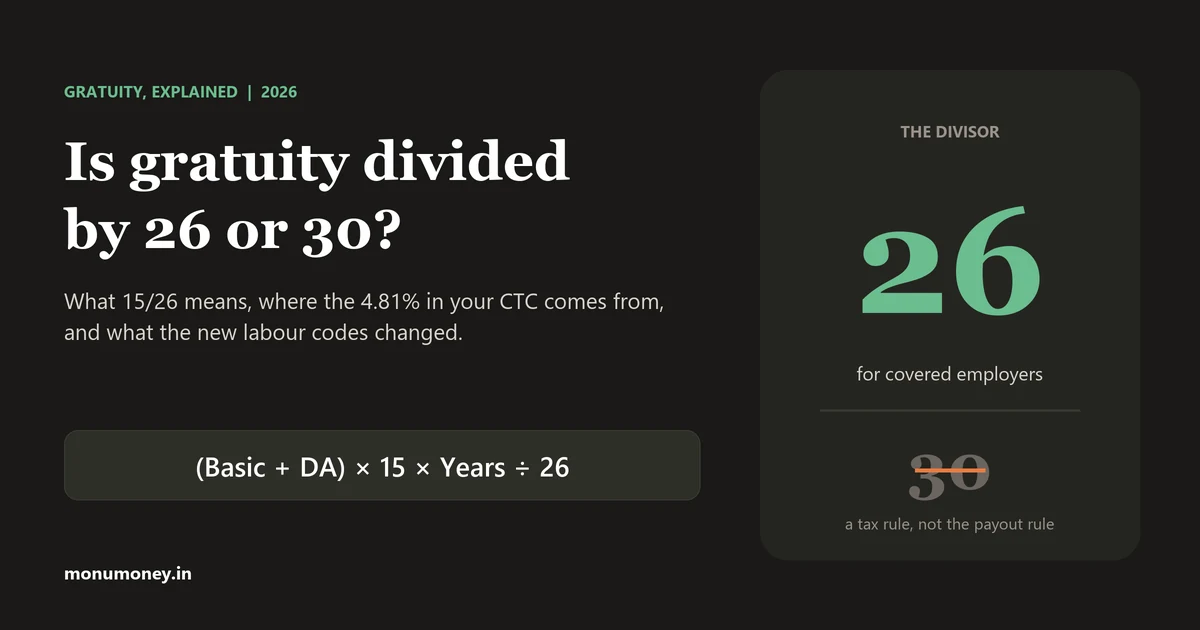
Is Gratuity Divided by 26 or 30? The 15/26 Formula Explained
The 26 in the gratuity formula comes from a 1980 Supreme Court ruling, and the new labour codes kept it. Here is what 15/26 means, when 30 applies instead, and why the bigger change in 2025 was to the salary figure that goes into the formula.
If your employer has ten or more employees, your gratuity is divided by 26. The number 30 shows up only in narrower cases, mostly at small employers that fall outside gratuity law, and it always produces a smaller payout. The formula most salaried people in India should use is:
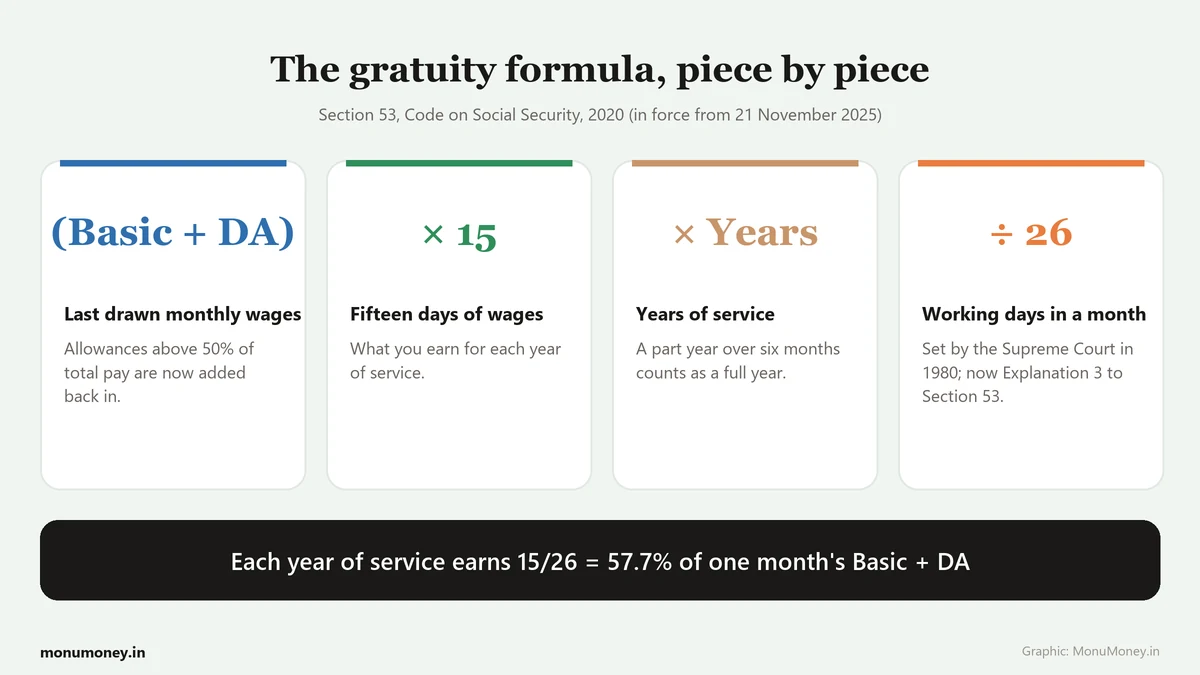
Gratuity = Last drawn (Basic + DA) × 15 × Years of service ÷ 26
That formula carried over unchanged when the Payment of Gratuity Act, 1972 was folded into the Code on Social Security, 2020, which came into force on 21 November 2025. The new law changed two other things: the salary figure you plug into the formula, and who qualifies after how many years. For many employees those changes move the final number far more than the 26-versus-30 question does. This guide covers all three with worked figures you can check on a calculator.
| Your situation | Divisor | How years are counted |
|---|---|---|
| Employer covered by gratuity law (10 or more employees) | 26 | Completed years, plus one more if the leftover period is over six months |
| Employer not covered, gratuity paid voluntarily | 30 (the tax rule uses half a month's average salary) | Completed years only |
| Central government employee | Not this formula | Governed by the CCS (Pension) Rules |
What 15/26 means, step by step
Read the formula from the inside out.
Your monthly Basic + DA divided by 26 gives a daily wage. The law treats a month as 26 working days, on the reasoning that a 30-day month contains about four weekly rest days. Multiply that daily wage by 15 and you get fifteen days of wages, which is what each year of service earns you. Multiply by your years of service and you have the total.
Put together, every year of service is worth 15/26 of one month's Basic + DA, or 57.7%. If the divisor were 30, the figure would be exactly 50%. Dividing by 26 gives you 15.4% more for every single year.
Why the number is 26
The 26 comes from a Supreme Court judgment. In Digvijay Woollen Mills Ltd. v. Mahendra Prataprai Buch (decided 23 July 1980), the employer argued that monthly wages should be divided by 30 to get a day's pay. The Court rejected that and held that a monthly wage is payment for 26 working days, so fifteen days' wages must be worked out on that basis. Parliament later wrote the rule into the Act itself.
The Code on Social Security kept the rule. Explanation 3 to Section 53 says that for a monthly-rated employee, fifteen days' wages are calculated by dividing the monthly rate of wages last drawn by twenty-six and multiplying the quotient by fifteen.
Two groups use different maths. For piece-rated workers, the daily wage is the average of total wages over the three months before leaving, excluding overtime. Workers in seasonal establishments who are not employed all year get seven days' wages for each season instead of fifteen.
When 30 is used instead of 26
Neither of the two situations applies to a typical salaried employee at a mid-sized or large company.
The first is an employer that is not covered by gratuity law. The gratuity chapter applies to establishments with ten or more employees. A smaller business has no legal duty to pay gratuity, although many do. When they pay it, the income-tax exemption is worked out as half a month's average salary for each completed year of service, using the average of the ten months before you leave. Half a month is 15/30. Most of the "divide by 30" advice online is this tax rule for non-covered employees, copied into general calculators where it doesn't belong.
The second is an employer's own policy. Some companies run gratuity schemes written around 30 days. The law lets an employer offer better terms than the statute, never worse. If your employer is covered and divides by 30, it is paying you less than the law requires, and you can take that up with HR and then with the labour authorities.
Worked example: same salary, three different cheques
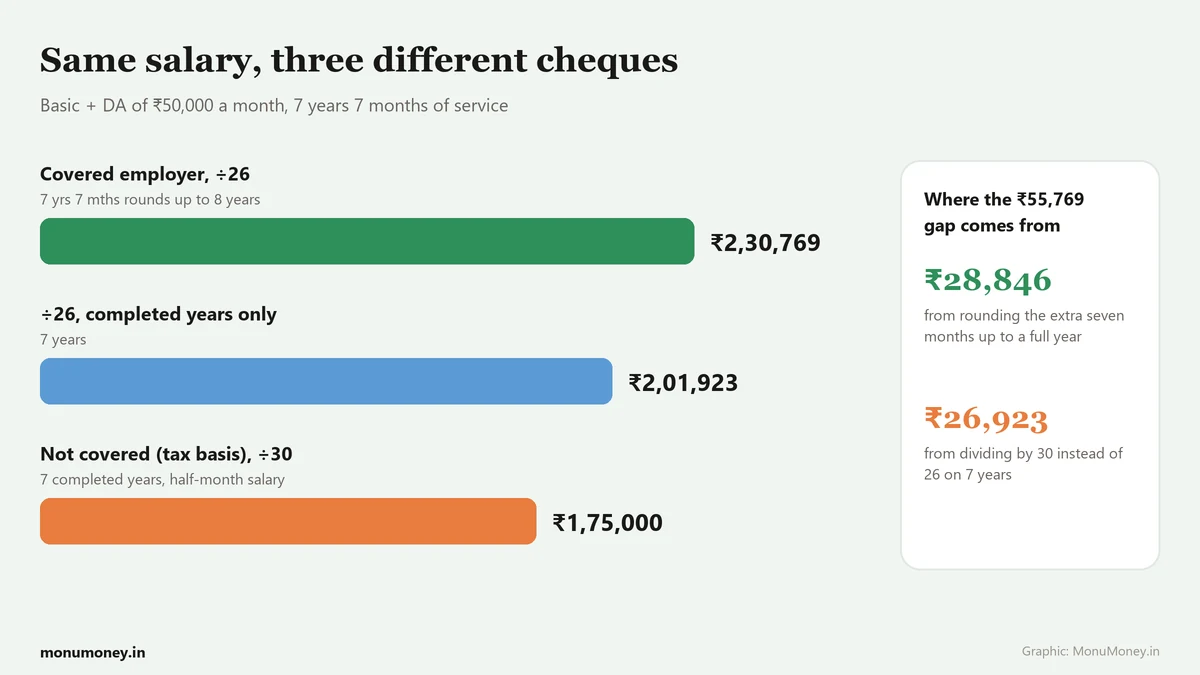
Take an employee with last drawn Basic + DA of ₹50,000 a month who leaves after 7 years and 7 months.
At a covered employer, the extra seven months exceed six, so the service counts as 8 years. The payout is 50,000 × 15 × 8 ÷ 26 = ₹2,30,769.
At a non-covered employer paying on the tax-rule basis, only the 7 completed years count, and the divisor is 30. The payout is 50,000 × 15 × 7 ÷ 30 = ₹1,75,000.
The gap is ₹55,769, and it splits almost evenly between the two rules. The rounding of seven months into a full year adds ₹28,846. Dividing by 26 instead of 30 on the same 7 years adds ₹26,923.
The rounding rule is worth planning around. Section 53(2) counts "part thereof in excess of six months" as a full year, and the wording says in excess of, so exactly six months does not count. If you are at 6 years and 5 months and thinking of resigning, staying past 6 years and 6 months adds a full year of gratuity. On ₹50,000 Basic + DA that is ₹28,846 for a few extra weeks of work.
Permanent employees still need five years of continuous service before any gratuity is due, except on death or disablement. Some High Courts have counted 4 years and 240 days as five years, using the 240-day rule for continuous service, but the courts have not been uniform on this, so don't build a resignation date around it without advice.
Where the 4.81% in your CTC comes from
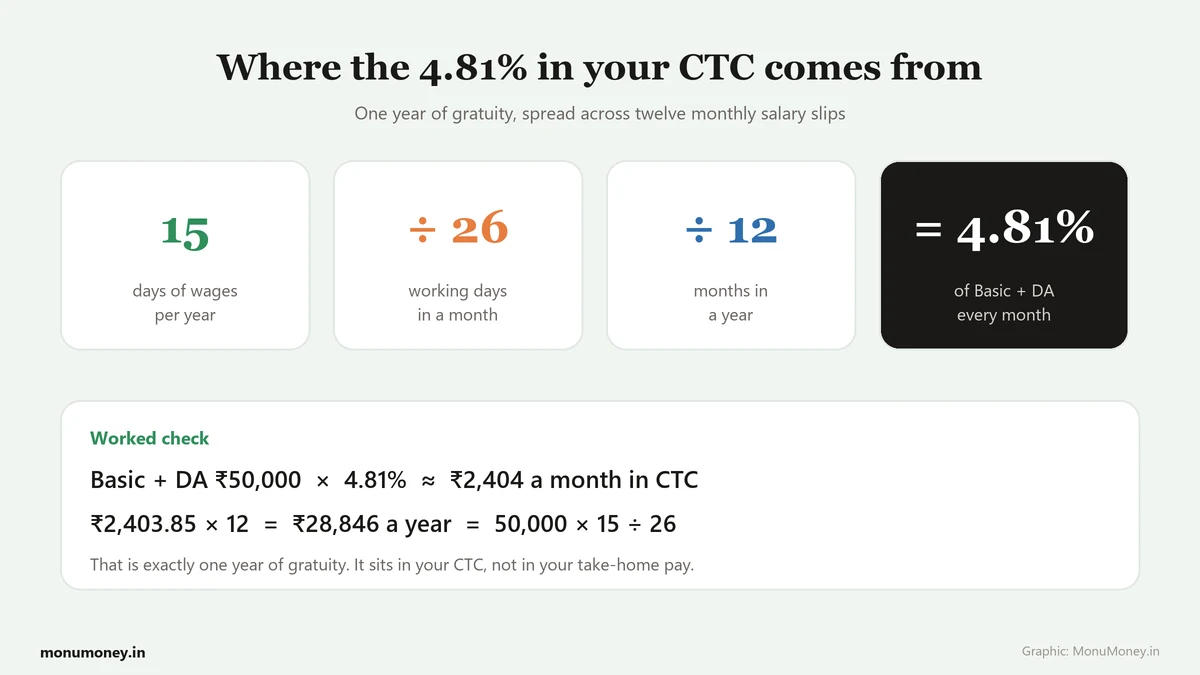
Offer letters often list gratuity as 4.81% of Basic. That number is the same formula spread over twelve months: 15 ÷ 26 ÷ 12 = 0.0481.
Check it with the ₹50,000 example. 4.81% of ₹50,000 is about ₹2,404 a month. Over a year that adds up to ₹28,846, which is exactly 50,000 × 15 ÷ 26, one year of gratuity. Your employer is setting aside, every month, the gratuity you earn for that year of service, either as a provision in its books or as a premium to a group gratuity policy with an insurer.
So the gratuity line is part of your CTC but never part of your take-home pay. If you are a permanent employee who leaves before five years, you never receive it, even though it was counted in your CTC every year. When you compare two job offers, subtract the gratuity line from each CTC unless you expect to stay five years.
What the 2025 labour codes changed
The four labour codes took effect on 21 November 2025, and the central rules under them were notified in May 2026. For gratuity, the formula stayed the same. The changes are elsewhere.
The 50% wage rule
This is the change most likely to raise your payout. The Code on Social Security defines "wages" in Section 2(88) and lists items that are excluded, such as HRA, conveyance allowance, overtime, commission, bonus and the employer's PF contribution. A proviso then says that if those excluded payments add up to more than half of your total remuneration, the amount above half is added back into wages.
You will often read that "Basic must now be 50% of CTC." The law doesn't say that. It caps how much of your pay can sit in excluded allowances, and anything above the cap counts as wages for gratuity, PF and other benefits whatever your payslip calls it.
Many companies kept Basic at 30 to 40% of pay and put the rest into allowances, which kept gratuity low. That structure no longer works. Take monthly remuneration of ₹1,00,000 with Basic + DA of ₹35,000 and ₹65,000 in excluded allowances. The allowances are ₹15,000 over the 50% line, so wages for gratuity become ₹50,000.
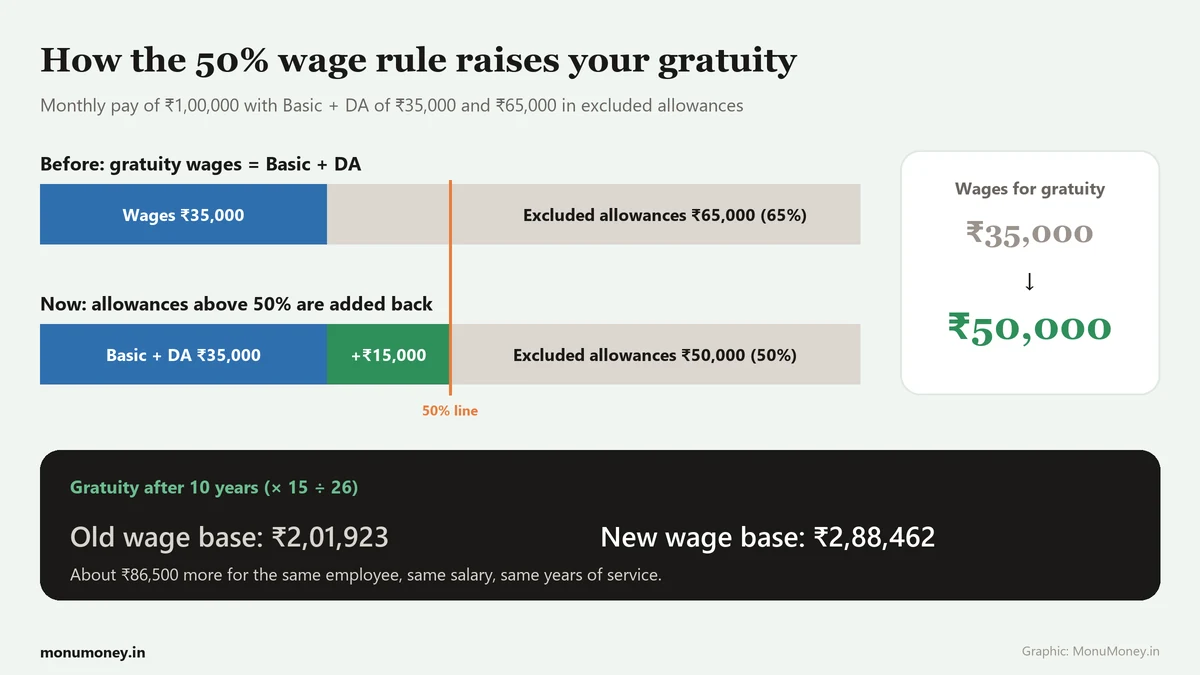
After 10 years, the old base gives 35,000 × 15 × 10 ÷ 26 = ₹2,01,923. The new base gives 50,000 × 15 × 10 ÷ 26 = ₹2,88,462. That is about ₹86,500 more for the same person on the same salary.
Fixed-term employees qualify after one year
Employees on a fixed-term contract now get gratuity on a pro rata basis after one year of service, instead of five. The formula and the divisor of 26 are the same. A fixed-term employee on ₹40,000 a month who completes one year gets 40,000 × 15 ÷ 26 = ₹23,077. An 11-month contract does not meet the one-year threshold. Whether back-to-back renewals add up to one year isn't clearly settled in the official material yet, so keep every contract and joining letter.
The ceiling is still ₹20 lakh
The statutory ceiling for private-sector gratuity remains ₹20 lakh. The cap is higher than most people's payout but closer than it looks for senior staff: with 25 years of service, Basic + DA of about ₹1.39 lakh a month is enough to hit it. The employer must pay within 30 days of the gratuity becoming payable, and a late payment carries simple interest.
How gratuity is taxed
For an employee covered by gratuity law, the tax-free amount is the lowest of three figures: the amount worked out with the 15/26 formula, ₹20 lakh, and the gratuity actually received. Anything above that is taxed as salary. For a non-covered employee, the first figure is replaced by half a month's average salary for each completed year. The ₹20 lakh is a lifetime limit across all your employers, not a per-job limit.
The exemption is available under both the old and the new tax regime. The Income-tax Act, 2025 replaced the 1961 Act from 1 April 2026, and the exemption that used to sit in Section 10(10) has carried over with the same ₹20 lakh limit. Check the current schedule references when you file, because many guides still quote the old section numbers. If you are weighing regimes for the year you retire, the old vs new tax regime calculator will show the difference.
Check your own gratuity in five steps
- Find your Basic and DA on your latest payslip.
- Add up the excluded allowances (HRA, conveyance and the like). If they are more than half of your total monthly pay, add the excess to Basic + DA.
- Count your service in completed years. At a covered employer, add one year if the leftover period is more than six months.
- Multiply wages × 15 × years and divide by 26.
- Cap the result at ₹20 lakh.
The MonuMoney gratuity calculator does steps 3 to 5 for you. For the full picture of what you leave with, estimate your PF balance with the EPF calculator and put both numbers into the retirement calculator.
Frequently asked questions
Is gratuity calculated on basic salary or gross salary?
Gratuity is calculated on wages, which means Basic plus Dearness Allowance, not gross salary. Under the Code on Social Security, 2020, if excluded allowances such as HRA and conveyance make up more than 50% of your total pay, the amount above 50% is added back to wages, so the base can be higher than your Basic + DA.Why is gratuity calculated on 26 days and not 30?
The Supreme Court held in Digvijay Woollen Mills v. Mahendra Prataprai Buch (1980) that a monthly wage is payment for 26 working days, since a month has about four weekly rest days. The rule was later written into the Payment of Gratuity Act and is now Explanation 3 to Section 53 of the Code on Social Security, 2020.How much gratuity will I get for 5 years on a basic salary of 30,000 rupees?
At a covered employer, gratuity for 5 years on Basic + DA of 30,000 rupees is 30,000 × 15 × 5 ÷ 26, which is 86,538 rupees. If your allowances exceed half of your total pay, your wage base and the payout will be higher.Can my employer use 30 days instead of 26 to calculate gratuity?
A covered employer can pay more than the law requires but not less. Dividing by 30 gives a smaller amount, so a covered employer using 30 is underpaying. The 30-day basis applies to employers outside gratuity law, through the income-tax rule of half a month's average salary per completed year.Will I get the 4.81% gratuity in my CTC if I leave before 5 years?
No, not if you are a permanent employee. The 4.81% is the employer setting aside one year of gratuity in monthly instalments, and it becomes payable only after five years of continuous service, except on death or disablement. Fixed-term employees qualify after one year.Sources
- Code on Social Security, 2020 (full text, India Code): Section 2(88) on wages and Section 53 on gratuity.
- Press Information Bureau: four labour codes made effective from 21 November 2025
- Digvijay Woollen Mills Ltd. v. Mahendra Prataprai Buch (1980), judgment text
- Khaitan & Co: central rules under the labour codes notified (May 2026)
- Business Today: new gratuity rules for fixed-term employees (April 2026)
- Business Standard: tax-free gratuity ceiling raised to ₹20 lakh
This article explains the law as it stood on 14 November 2026. It is general information, not legal or tax advice. Your employer's payroll team or a labour law professional can confirm how the rules apply to your contract.
Official Sources & Verification
To ensure accuracy, the formulas, rules, and tax provisions used on this page are verified against official government, regulatory, or institutional sources.
- Income Tax Department of India
- Union Budget & Finance Bill
- Reserve Bank of India (RBI)
- Securities and Exchange Board of India (SEBI)
Last Verified: November 14, 2026